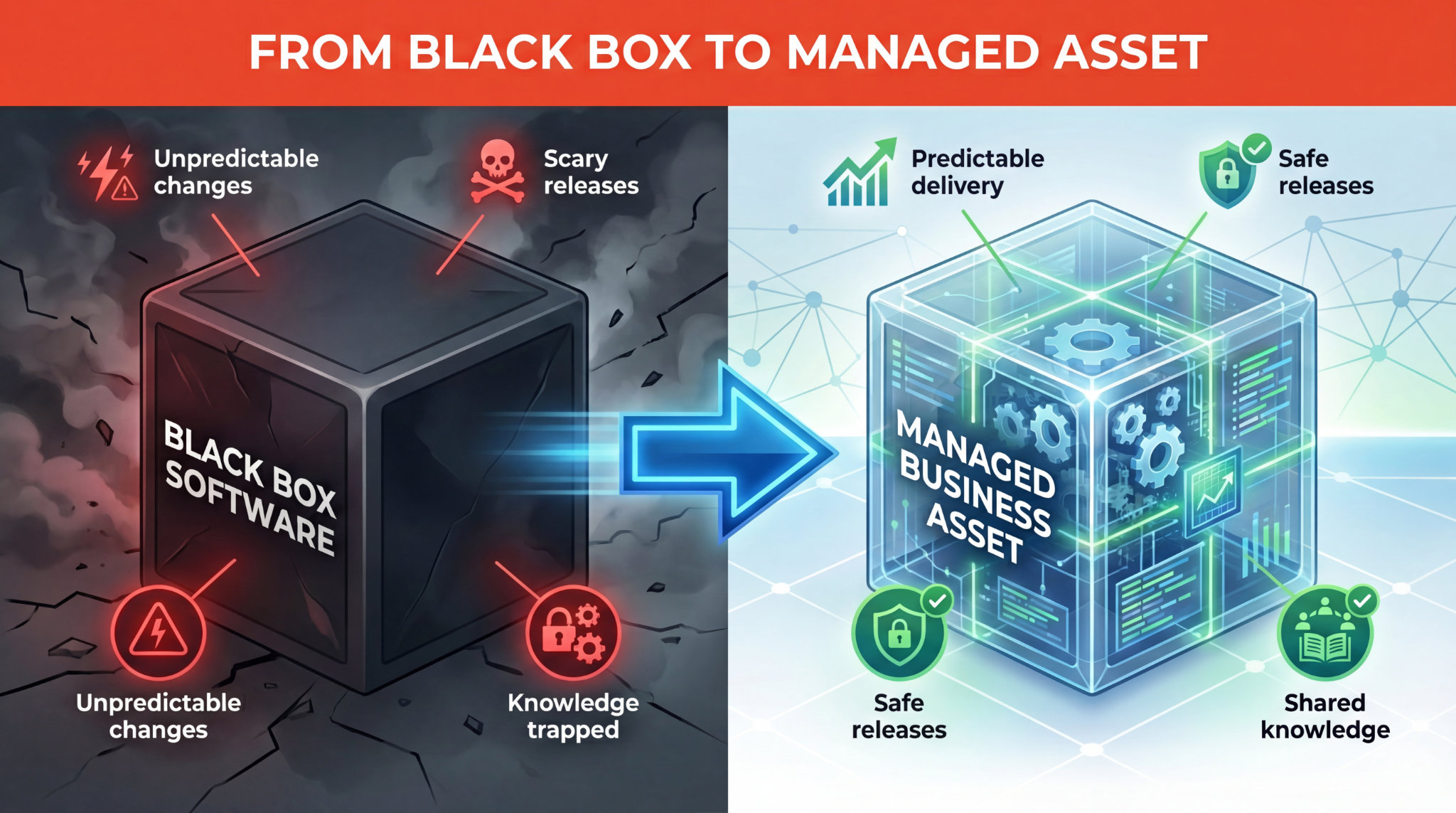
Most SMEs treat software like “an IT thing.” But if your business runs on software, then software is part of operations — it directly affects growth, customer experience, and costs.
When the system is healthy, you can ship improvements quickly and safely. When it’s fragile, everything becomes slow, expensive, and stressful.
How software risk hits the business
Software risk shows up in three places:
1) Speed
How fast you can ship improvements and respond to the market. Fragile systems slow teams down because every change feels uncertain.
2) Safety
Whether changes cause outages, bugs, refunds, or support spikes. Healthy software doesn’t mean “no bugs” — it means failures are contained and recoverable.
3) Cost
Not just dev salaries. The biggest cost is often delay and firefighting:
- incidents and downtime
- emergency fixes
- missed opportunities
- growing support load
The “black box” trap
As the business grows, systems become more complex. Then leadership often reacts in one of two ways:
- “Ship faster” → usually creates more bugs and stress
- “Rewrite it properly” → high risk, long timelines, scope creep
A safer approach is almost always the third option:
De-risk the system incrementally. Reduce uncertainty step by step, without stopping the business.
4 signs your software is high risk
You don’t need to read code to spot risk. Watch what happens when the system changes.
Changes are unpredictable A “small task” regularly becomes weeks.
Small changes break unrelated things Fix billing, checkout breaks. That’s a large blast radius.
Releases are scary Deployments happen late at night with everyone on standby.
Knowledge is trapped in 1–2 people “Only Steve knows how it works” is a serious business risk.
If you recognise two or more, your software is operating with high uncertainty — and that’s what drives cost and slows growth.
What healthy software looks like (business outcomes)
Healthy software behaves like a well-run operation:
- predictable delivery
- routine releases
- reversible changes
- faster recovery when something breaks
- knowledge shared across the team
This isn’t about “new tech.” It’s about making change safe and repeatable.
5 questions you can ask this week
Use these with your dev team or vendor:
- How confident are you when you deploy?
- If we change X, what else might break?
- If a key developer left tomorrow, what happens?
- How do we know we haven’t broken something?
- What’s our biggest technical risk — and the plan to reduce it?
You’re not looking for perfect answers. You’re looking for proof that risk is being managed on purpose, not by luck.
The takeaway
Your software is a business asset. If it’s fragile, it becomes a growth limiter. If it’s healthy, it becomes a competitive advantage.
The goal isn’t “move fast at all costs.” The goal is move fast because it’s safe to change.