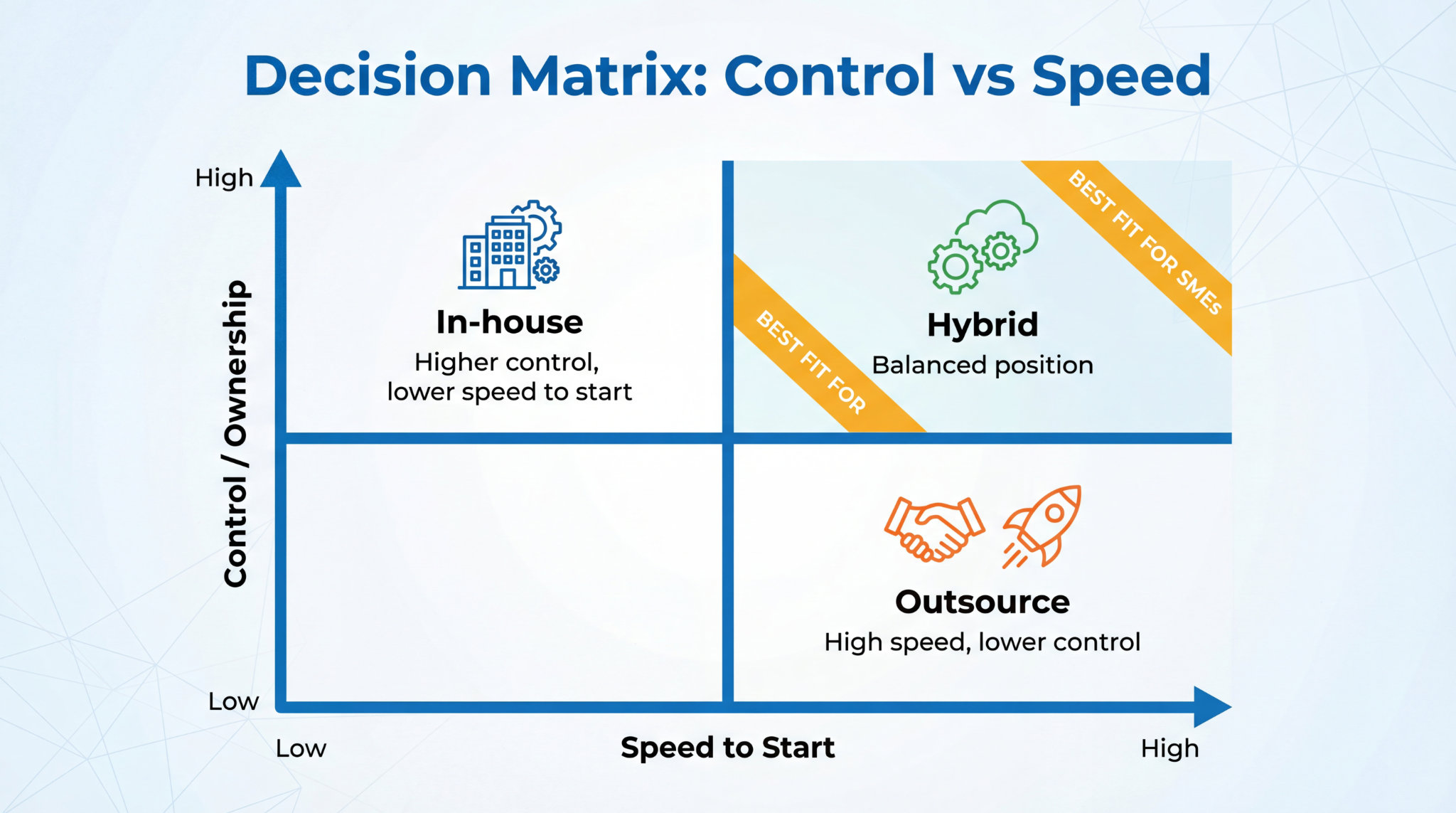
For most SMEs, the hardest part of building software isn’t choosing a tech stack. It’s choosing how to staff delivery: outsource, in-house, or a mix.
Many leaders make this decision based on day rates. That’s understandable—but it’s rarely the best way to think about it.
Because the real cost isn’t the day rate. It’s risk, speed, ownership, and continuity.
This post will help you choose the right model without needing to be technical.
The 3 delivery models (and what they really mean)
1) Fully outsourced (agency / freelancers)
You hire external developers to build and maintain the product.
Best for:
- quick execution when speed matters
- projects with clear scope and outcomes
- early-stage companies without tech leadership
Main risk: You may receive working software, but not long-term capability.
2) Fully in-house team
You employ developers directly, manage delivery internally, and keep knowledge inside the business.
Best for:
- businesses where software is core to competitive advantage
- long-term product roadmaps
- systems that need constant iteration
Main risk: Higher fixed cost and slower ramp-up if you don’t have strong leadership.
3) Hybrid (recommended for many SMEs)
A small internal team owns the system, supported by external specialists when needed.
Best for:
- modernisation programs (legacy + new work)
- SMEs that need flexibility
- stable long-term progress without over-hiring
Main risk: You need clear boundaries and ownership, or work becomes fragmented.
The hidden costs CEOs underestimate
1) The cost of misalignment
External teams can build exactly what you asked for… even if it’s not what the business needs.
The more complex the product, the more valuable it becomes to have people who understand:
- your customers
- your operational constraints
- your priorities and trade-offs
This knowledge doesn’t sit in Jira tickets. It sits in people’s heads.
2) The cost of churn
If developers rotate frequently—internally or externally—your system becomes a “knowledge debt” machine.
Symptoms include:
- decisions that get repeated
- bugs that return
- slow onboarding
- constant rewrites of the same components
Continuity is one of the strongest predictors of delivery speed.
3) The cost of weak ownership
The biggest danger with outsourcing is not quality. It’s responsibility gaps.
When something breaks, who owns:
- the incident response
- the fix
- the root-cause analysis
- preventing it next time
If the answer is unclear, the business pays in downtime and stress.
A practical decision framework for SMEs
Use these four questions to choose the right approach:
1) Is software mission-critical to revenue?
If your business can’t operate without it, you need internal ownership, even if delivery is partly outsourced.
2) Are requirements changing weekly?
If yes, you need people who can adapt quickly and understand context. That usually points to in-house or hybrid.
3) Do you have technical leadership?
If you don’t have someone who can define quality, process, and architecture decisions, fully in-house can fail. In that case, start with outsourcing + strong advisory support, and grow from there.
4) What happens if one key person disappears?
If the answer is “we’d be stuck,” you have concentration risk. That’s a sign you need better documentation, shared knowledge, and a safer operating model.
5 due-diligence questions to ask any agency or contractor
- How do you release safely and how often?
- How do you prevent regressions in legacy systems?
- What does success look like in 30/60/90 days?
- How do you document decisions and onboard others?
- Who owns reliability after delivery?
A serious partner will answer clearly. A risky one will answer vaguely.
The takeaway
Outsourcing isn’t bad. In-house isn’t automatically better. The winning model is the one that gives you:
- speed without chaos
- ownership without bottlenecks
- continuity without dependence on one person
For many SMEs, that’s hybrid: internal ownership plus external support.
The real cost isn’t the day rate. It’s whether your delivery model reduces risk and improves your ability to change the system month after month.