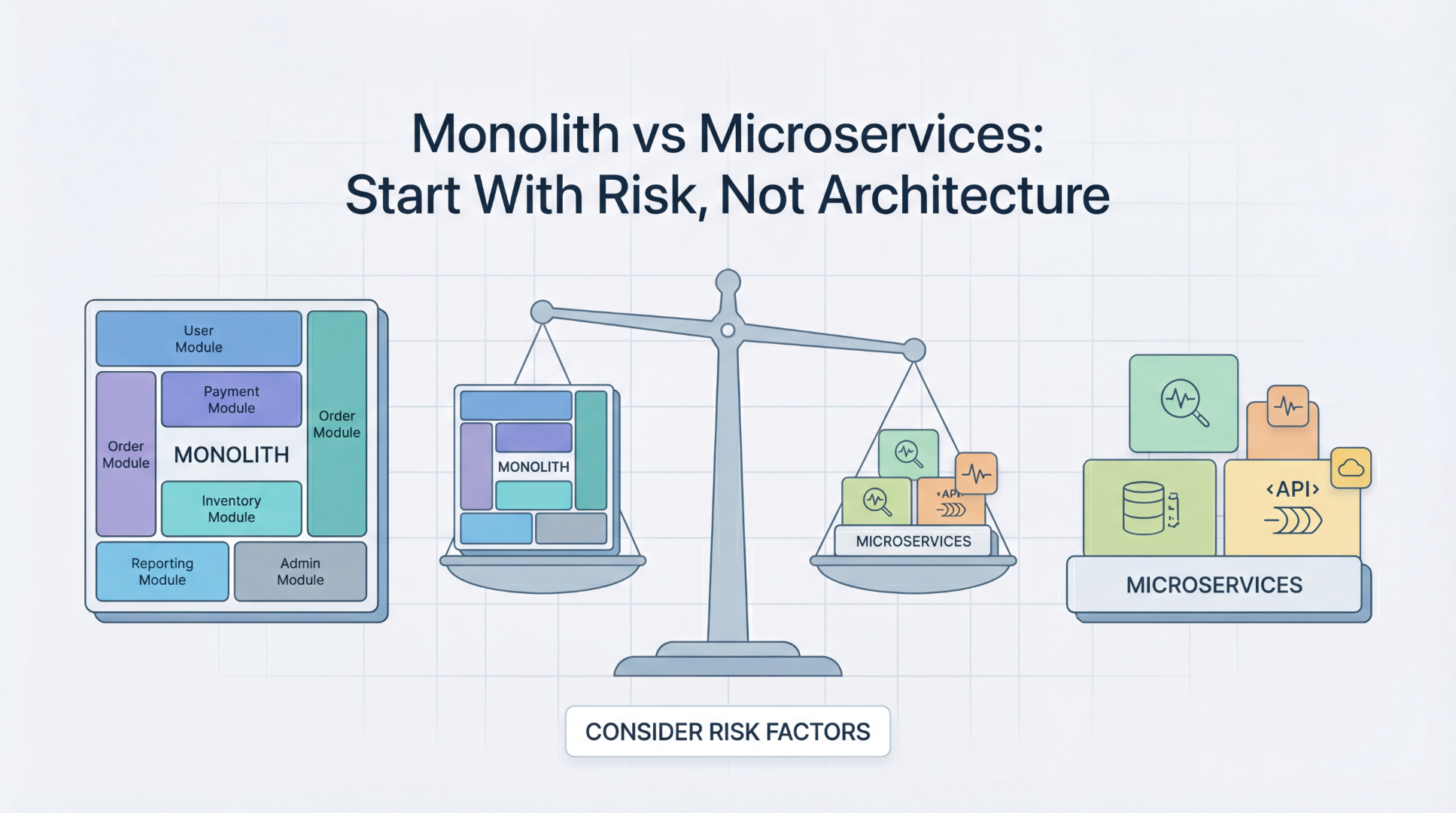
If you’ve ever heard “We need microservices” as the solution to slow delivery, outages, or a fragile system — pause.
Microservices can be a great tool. They can also multiply complexity and cost, especially for SMEs.
The right question usually isn’t “Should we use microservices?” It’s “Where is the risk in our system, and how do we reduce it safely?”
This post gives you a practical, non-technical way to think about monoliths, microservices, and modernisation decisions.
What a monolith really is (and why it’s not automatically bad)
A monolith is simply a system where many parts are deployed together as one unit.
That can be perfectly fine. In fact, many successful companies run monoliths for years because:
- it’s simpler to operate
- changes are easier to coordinate
- there’s one deployment pipeline
- debugging can be straightforward
A monolith becomes a problem when it evolves into a fragile monolith — where changes are slow and unpredictable.
What microservices really are (and why they’re not automatically good)
Microservices are a set of small services that can be deployed independently. Each service is responsible for a bounded slice of the system (for example: billing, search, notifications).
Microservices can help when:
- teams need independent delivery
- different parts of the system scale differently
- failures should be contained (“blast radius”)
- you want to modernise incrementally
But microservices also introduce real overhead:
- more deployments
- distributed debugging
- more monitoring/logging
- network failures and latency
- data consistency challenges
- versioning across services
For many SMEs, microservices increase risk if the operational basics aren’t in place.
The real enemy: uncontrolled risk
SMEs often feel the pain here:
- “We can’t change that without breaking something.”
- “Releases are stressful.”
- “Only one person understands this area.”
- “Small changes take forever.”
That’s not a monolith problem. It’s a risk management problem.
The goal is to reduce uncertainty and make change safer — regardless of architecture.
A CEO-friendly framework: the 3 types of system risk
When deciding whether to stay monolith, modularise, or move toward microservices, assess three categories:
1) Delivery risk
Symptoms
- unpredictable estimates
- frequent regressions
- long release cycles
What reduces it
- tests around critical behaviour
- smaller, safer releases
- clearer ownership and boundaries
2) Operational risk
Symptoms
- outages that cascade
- difficult incident response
- no clear observability (logs/metrics)
What reduces it
- monitoring and alerting
- standardised logging and tracing
- rollbacks, feature flags, gradual rollout
3) Dependency risk
Symptoms
- one component blocks everything
- a single database is a bottleneck
- third-party failures break core flows
What reduces it
- decoupling, queues, timeouts
- fallback behaviour
- isolating high-risk dependencies
Once you know which risk dominates, the right architecture becomes clearer.
When microservices are a good idea (practical signs)
Microservices tend to be justified when you have at least one of these realities:
- Multiple teams need to ship independently without stepping on each other
- Parts of the system have different scaling needs (e.g., search vs checkout)
- Failures must be contained (one area going down shouldn’t take everything down)
- The legacy system is blocking progress, and you want to extract slices gradually
- You have strong operational maturity (CI/CD, monitoring, on-call discipline)
If none of these are true, “microservices” is often a costly detour.
When microservices are a bad idea (common SME trap)
Microservices often go wrong in SMEs when:
- the goal is “modern tech” rather than solving a specific risk
- the team lacks strong CI/CD and observability
- service boundaries are unclear (“we split it but it’s still coupled”)
- the organisation can’t support the operational load
- you end up with distributed complexity and slower delivery than before
Rule of thumb: if deployments are already stressful, microservices won’t fix that — they will multiply it.
The low-risk alternative: “modular monolith” + gradual extraction
For many SMEs, the best path is:
- Keep a monolith but improve internal boundaries (modular monolith)
- Reduce delivery risk with testing and safer release practices
- Extract only the highest-risk or highest-change areas over time
This gives you many benefits of microservices — without jumping immediately into distributed systems complexity.
The decision you can make today
If you’re leading an SME, here’s a practical way to move forward:
Ask your team this:
- What part of the system creates the most production incidents?
- What part slows delivery the most?
- What part has the biggest blast radius when it breaks?
- If we could “contain” one area, what would it be?
If you get clear answers, you’re ready for a modernisation plan — and it might include microservices. If you don’t, the first step is visibility and risk mapping, not architecture.
The takeaway
A monolith isn’t the enemy. Microservices aren’t a magic upgrade.
The winning approach is to:
- identify where risk is concentrated
- reduce uncertainty with safer delivery
- improve boundaries and observability
- modernise incrementally, only where it pays off
Start with risk. The architecture will follow.